The cooling tower may sit at the far end of the cooling chain, but when its performance starts to slip, the effects can reach all the way back to the process it supports.
When people talk about cooling in modern data centers, the conversation usually starts close to the IT load. Liquid cooling, chillers, CRAH and CRAC units, and increasingly powerful rack-level cooling systems tend to get most of the attention. But eventually, all that heat has to go somewhere, and for facilities using evaporative cooling towers, the tower is a critical part of that heat-rejection chain.
When tower performance begins to decline, the problem may not immediately look like a cooling tower problem. Operators may instead see warmer return water, higher energy use, reduced cooling capacity, or difficulty maintaining performance during hot weather. Because those changes can develop gradually over weeks or months, an annual inspection only provides a snapshot of what is happening. Cooling tower condition monitoring provides something different: visibility into how the tower is actually performing between those inspection points.
Why Annual Inspection Cycles Fall Short for Cooling Towers
Periodic cooling tower inspections still serve an important purpose. They give teams an opportunity to visually inspect equipment, perform maintenance, and address known problems. But inspection frequency can vary depending on the equipment, operating environment, and conditions. For example, the Cooling Technology Institute's guidance for winter operation calls for frequent visual inspections under certain cold-weather conditions and continuous monitoring of return water temperature.
What periodic inspections cannot provide is visibility into everything that happens between them. Cooling towers are dynamic systems, with fans, motors, pumps, fill, spray systems, water flow, ambient conditions, and other components all influencing how effectively the tower rejects heat. As those conditions change, performance can gradually move away from where it should be without creating an obvious failure.
A tower might still be operating while using more fan or pump energy than necessary. A fan-control issue may reduce airflow, while fill or nozzle problems can limit heat transfer. Changes in water flow or other operating conditions can also reduce capacity. Across more than 50 site assessments, every cooling tower assessed was found to be underperforming.
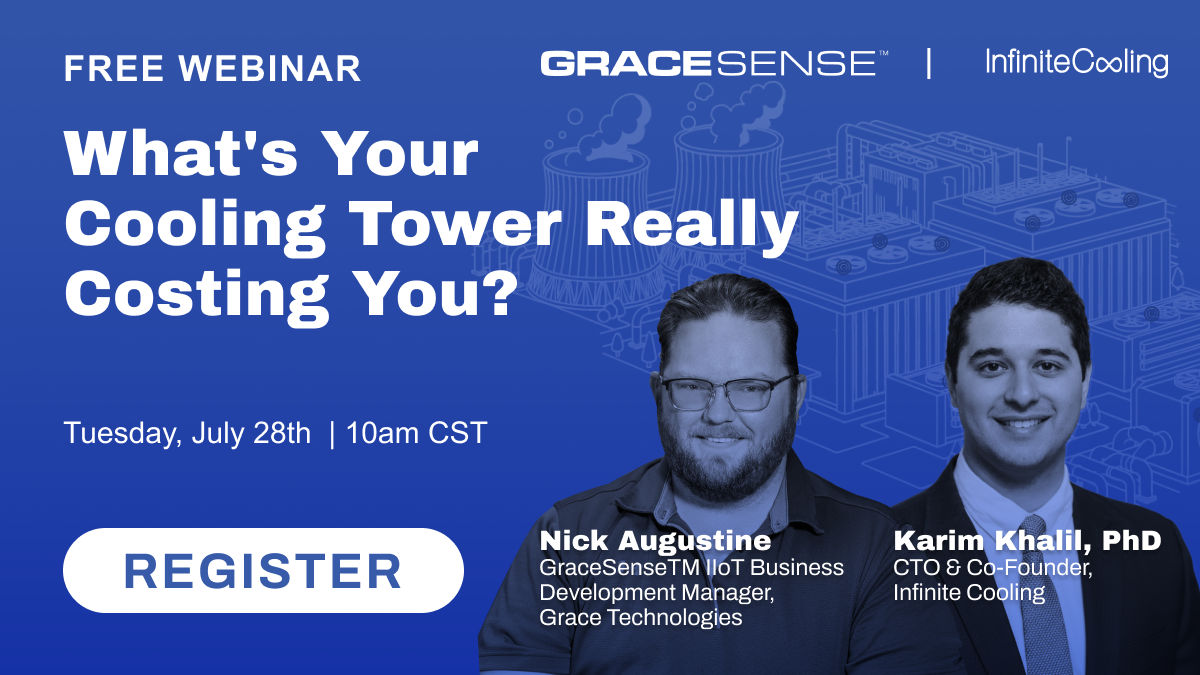
The challenge is that underperformance is not always obvious from conventional operating data. During the recent Grace Technologies and Infinite Cooling webinar, two towers were shown with raw operating data that appeared remarkably similar even though one had lost more than 25% of its efficiency. An inspection can tell you what the tower looked like when someone checked it. Continuous monitoring can help show how its performance is changing over time.
What Continuous Condition Monitoring Looks Like for a Cooling Tower
A cooling tower monitoring system goes beyond collecting another set of sensor readings. The GraceSense™ and TowerPulse™ approach combines wireless sensing with physics-informed analytics to continuously evaluate tower performance and translate operating data into information maintenance and operations teams can use.
GraceSense sensors can collect real-time operating data including temperature and flow, humidity and wet-bulb conditions, and fan speed and power. Depending on the instrumentation already available at the facility, measurements can also include air temperatures at tower inlets and exhaust, along with water flow rates and pressures. Existing site data can be incorporated rather than unnecessarily duplicating sensors already in place.
TowerPulse then analyzes that live data using physics-informed models of cooling tower performance. Instead of asking operators to interpret a collection of changing trend lines, the platform evaluates four areas: capability, efficiency, maintenance, and water use. Those scores can help teams understand whether the tower is rejecting as much heat as it should, whether fans and pumps are operating efficiently, whether issues involving fill, nozzles, airflow, or mechanical components may be developing, and where water may be lost.
The platform is also designed to quantify the impact of identified issues in dollars, kilowatt-hours, and gallons and provide recommended actions prioritized by impact. That creates a different maintenance conversation. Instead of only asking, What does the tower look like today?, teams can begin asking, How has it been performing, what is changing, and where should we look next?
Continuous condition monitoring does not eliminate inspections or replace the expertise of operations and maintenance teams. It gives those teams more information to determine where and when their attention may be needed.
For a deeper look at how the technology works, watch the GraceSense and Infinite Cooling webinar on demand!
Why This Matters More as Data Centers Scale
The timing of this shift matters because the cooling requirements of modern data centers are changing. According to Uptime Institute's 2026 Data Center Operations and AI Survey, operators are actively navigating how AI workloads, rack densities, and cooling systems fit together. Uptime's research also notes that the broader trend continues toward increased rack density as higher-powered silicon and richer server configurations place greater thermal demands on facilities.
That is also driving greater interest in liquid cooling. Uptime Institute's research on direct liquid cooling points to the rapid expansion of high-density AI infrastructure as a major factor behind its increased deployment. But changing how heat is removed from the IT equipment does not eliminate the need to ultimately reject that heat from the facility.
For data centers that rely on evaporative cooling towers as part of that process, tower performance remains an important part of the larger data center cooling infrastructure. As cooling demand grows, hidden efficiency losses can become harder to ignore. A tower operating below its potential may require more energy to achieve the same cooling result or become a constraint during periods of high ambient temperature and heavy facility load.
Knowing that a tower is underperforming, however, is only part of the problem. Teams also need to understand why. In one example discussed during the Grace Technologies webinar, a facility suspected that recirculation was causing a cooling problem and was considering a multimillion-dollar project to address it. After instrumenting the system, the analysis showed that recirculation was not actually the problem, helping the facility avoid investing in a solution that would not have addressed the underlying performance issue.
That is where continuous condition data becomes valuable. It can give teams operating evidence to investigate the actual source of a performance problem before deciding what needs to change.
From Annual Snapshots to Cooling Tower Intelligence
Annual inspections still matter. So do experienced operators, maintenance teams, water-treatment professionals, and cooling tower specialists. Continuous condition monitoring does not replace those resources. Instead, it can help fill in the months of operating history between individual inspection points.
Through the GraceSense™ and TowerPulse™ Cooling Tower Intelligence solution, wireless GraceSense sensors provide real-time operating data while TowerPulse applies physics-informed AI to evaluate tower performance, identify developing issues, and provide prioritized recommendations. The system can also work with existing facility infrastructure, including PLC, SCADA, and CMMS environments.
That visibility continues after an initial issue is corrected. In one TowerPulse deployment discussed during the webinar, the system remained active after the facility addressed its original thermal-performance problems. Six months later, it identified another controls-related issue affecting a fan, allowing the facility to investigate and correct a problem that developed well after the original work was complete.
For data centers and other high-uptime facilities, that is the bigger opportunity. Instead of periodically checking whether a cooling tower appears healthy, teams can build a more complete picture of how the tower is performing over time and use that information to make more targeted maintenance and operational decisions.
See What Your Cooling Tower Is Hiding
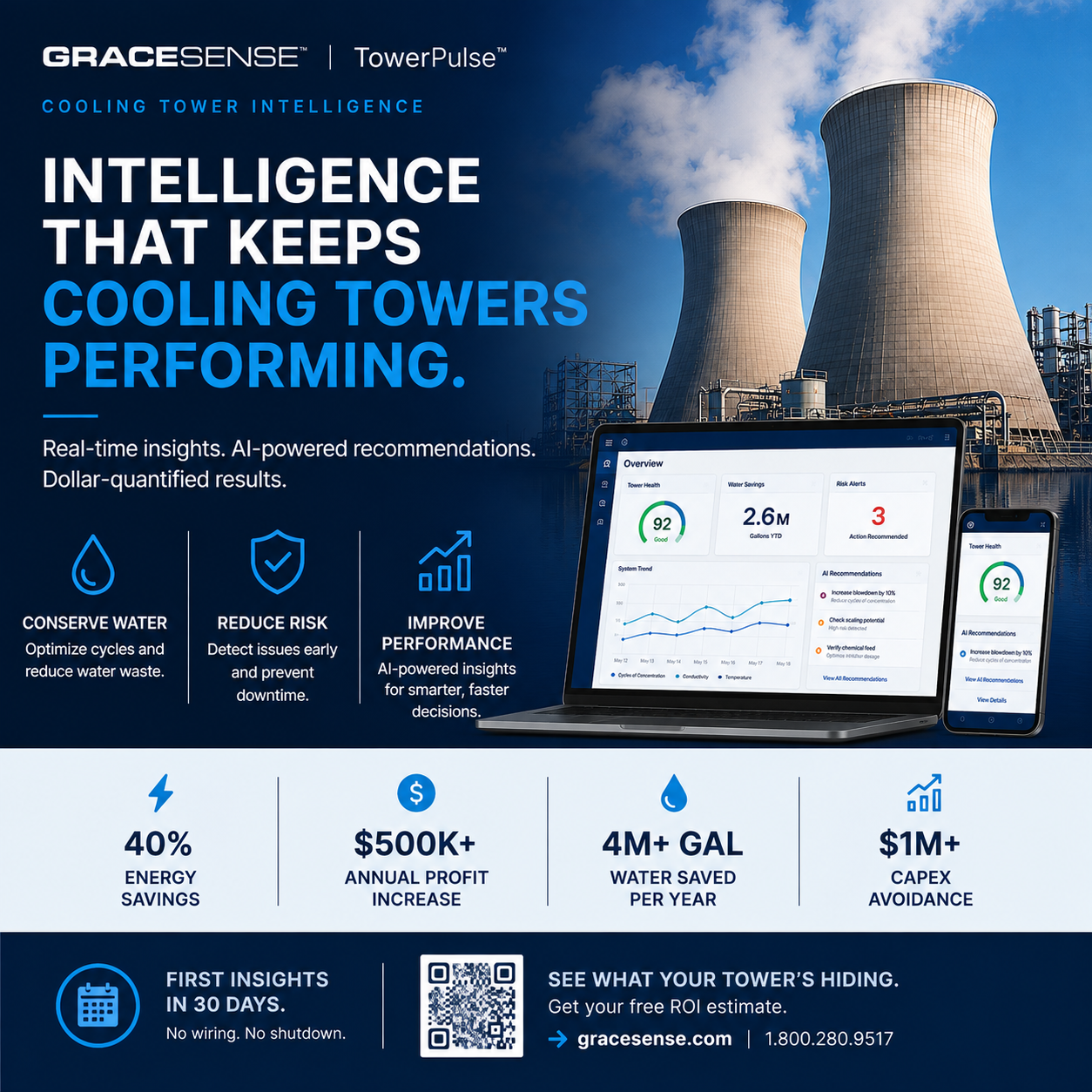
How much cooling capacity, energy, water, or operating cost could be hiding in your current tower performance? GraceSense™ sensors and TowerPulse™ AI combine real-time monitoring with cooling tower intelligence to help facilities identify performance losses, understand their potential impact, and prioritize what to address first.
With no shutdown required and initial insights available within 30 days, teams can gain a clearer picture of how their cooling towers are actually performing and where opportunities for improvement may exist.

To safer, smarter operations,