NFPA 70B applies to data center electrical equipment throughout the critical power chain, including switchgear, transformers, UPS systems, and transfer switches. Its maintenance approach considers equipment condition, not just the calendar. Planned maintenance paths and continuous monitoring help operators assess equipment between maintenance windows without treating uptime as an exception to required work.
Every data center faces a maintenance paradox: the electrical equipment supporting continuous operations needs regular attention, yet taking that equipment offline can put critical loads at risk. For facilities teams, the challenge isn't deciding whether maintenance matters. It's finding a way to complete it without creating a new reliability problem.
The 2026 edition of NFPA 70B provides a framework for that work. As we've discussed in electrical safety in data centers, uptime and worker safety need to be considered together.
Does NFPA 70B Apply to Data Centers?
Yes. NFPA 70B 2026 establishes electrical equipment maintenance requirements that are relevant to data centers just as they are to other facilities.
NFPA 70B is not itself a standalone OSHA regulation. Its enforceability at a particular facility can depend on adoption by the authority having jurisdiction, contractual obligations, or other applicable requirements. NFPA 70E addresses electrical safety-related work practices, including the importance of properly maintained equipment when evaluating electrical risk.
A condition rating is an assessment of equipment status based on factors such as maintenance history, inspection findings, test results, and available monitoring information. For more on the safety connection, see our discussion of condition of maintenance under NFPA 70E and NFPA 70B.
What Does NFPA 70B Cover in the Critical Power Chain?
In a data center, electrical reliability depends on more than one piece of equipment. Power travels through an interconnected system of switchgear, transformers, transfer switches, UPS systems, and distribution equipment before reaching the IT racks. Each component plays a role in keeping critical loads operating, which makes maintaining the entire electrical system essential.
NFPA 70B applies to electrical equipment throughout this critical power chain, but maintenance requirements aren't identical for every component. Different equipment types have their own inspection, testing, and servicing needs. Establishing an effective maintenance program means understanding those differences and evaluating equipment condition across the entire system.
The diagram below illustrates a typical data center power distribution path, from utility service through medium- and low-voltage equipment to the IT racks. It also highlights where continuous thermal monitoring solutions can provide additional visibility into equipment condition between scheduled maintenance activities.
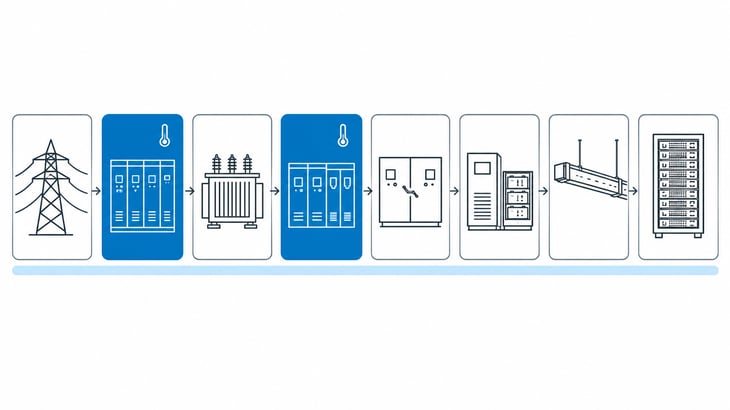
Data center critical power chain: Utility service → MV switchgear → Transformers → LV switchgear → Transfer switches → UPS systems and batteries → PDUs and busway → IT racks. Continuous thermal monitoring can support equipment condition assessments at selected locations along this path.
One important change in the 2026 edition of NFPA 70B is the addition of Chapter 39, which specifically addresses transfer switch equipment. This is particularly relevant to data centers, where automatic transfer switches and bypass-isolation configurations play important roles in maintaining power availability during source changes and planned maintenance.
For a closer look at this and other updates, read our article on what changed in NFPA 70B 2026.
Why Is NFPA 70B Harder to Follow in a Data Center?
In many industrial facilities, maintenance can be planned around production breaks or scheduled shutdowns. Data centers have fewer opportunities to interrupt critical power. Even when a maintenance window is available, a transfer or switching sequence can introduce operational risk that needs careful coordination.
NFPA 70E places important restrictions on energized electrical work; the desire to preserve uptime is not, by itself, permission to bypass electrically safe work practices. Qualified personnel must assess the task, equipment, and applicable requirements before work begins. A Permanent electrical safety devices such as the ChekVolt can support voltage verification steps within established electrical safety procedures, but does not replace required absence-of-voltage testing.
Design decisions can make that challenge easier or harder. Facilities with independent distribution paths and appropriate isolation provisions may be able to service equipment without interrupting the IT load. Others may need more extensive coordination, temporary operating arrangements, or a carefully scheduled outage.
Growing AI workloads add another layer of complexity. Higher rack power densities can increase demands on transformers, busway, switchgear, and their electrical connections. We explored that relationship in how rising rack densities affect data center switchgear.
What Happens When Electrical Maintenance Is Deferred?
In a data center, postponing electrical maintenance can feel like the safer choice when taking equipment offline puts critical operations at risk. But deferred inspections and servicing let developing problems go unnoticed, and they make the eventual maintenance harder to plan.
NFPA 70B uses equipment condition ratings to set maintenance frequency. Equipment that misses two consecutive maintenance cycles moves to Condition 3, which shortens its maintenance intervals. For example, infrared thermography moves from every 12 months to every 6. Deferring maintenance doesn’t buy time. It adds more work, sooner. See how NFPA 70B sets maintenance intervals for the full breakdown.
The 2026 edition also requires facilities to set timelines for completing necessary repairs and corrective actions. Finding a problem is no longer enough. Teams need to document it and follow a plan to resolve it.
Can’t get a maintenance window? Continuous monitoring documents equipment temperature trends between scheduled maintenance opportunities. It doesn’t replace required maintenance, but it helps teams spot developing problems early and decide when corrective work should be scheduled.
How Does Concurrent Maintainability Make NFPA 70B Workable?
Concurrent maintainability means a facility can take a capacity component or distribution path offline for planned maintenance while the critical IT load continues operating. It's a design characteristic associated with Uptime Institute's Tier III classification, not an assumption that every data center has that capability.
Where the electrical architecture supports it, teams may isolate one distribution path, maintain its equipment, and keep the load supported through another path. That creates opportunities to perform work under appropriate electrical safety conditions rather than treating energized maintenance as the default.
But redundancy alone isn't a maintenance plan. Before switching or isolating equipment, the team needs to confirm current load, available capacity, equipment status, protective arrangements, and the effects of a component being unavailable. Procedures, approvals, qualified personnel, and contingency planning still matter.
A practical schedule maps specific NFPA 70B tasks to the actual opportunities created by the site's design. Some work can be performed during planned maintenance on an isolated path. Other activities may require coordination across operations, electrical contractors, and customers. And where concurrent maintainability is limited, the maintenance program needs to acknowledge that constraint rather than simply leaving work unfinished.
How Does Continuous Monitoring Help Between Maintenance Windows?
Periodic infrared thermography is an important part of electrical maintenance, but it only captures equipment conditions at the time of inspection. Depending on the equipment and inspection method, accessing energized components may also require additional safety precautions. Continuous thermal monitoring complements these inspections by measuring temperatures at selected electrical connections over time, providing maintenance teams with visibility between scheduled maintenance windows.
For example, a switchgear connection may appear normal during an infrared scan but begin deteriorating weeks later. Permanently installed sensors can help identify developing temperature changes while equipment remains closed, allowing teams to investigate concerns before the next scheduled inspection.
This approach also supports the potential failure-to-functional failure (P-F) curve method introduced in NFPA 70B 2026. The P-F interval represents the time between when equipment deterioration first becomes detectable and when it can no longer perform its intended function. Identifying potential issues earlier can give maintenance teams more time to evaluate findings, coordinate repairs, and plan corrective work around available maintenance windows.
Monitoring notifications and temperature trends can also contribute to NFPA 70B equipment condition assessments. However, continuous monitoring does not replace required inspections, testing, repairs, or qualified personnel. For more on this distinction, read why quarterly thermal inspections aren't enough for AI-era data centers.
Grace Technologies offers two solutions that support this approach. The GraceSense MV HSM provides continuous thermal monitoring for medium-voltage equipment, while the GraceSense HSM 600 supports low-voltage applications. The HSM 600 monitors up to 78 temperature points from a single cable and offers latching alarms, dew point monitoring, and network integration capabilities. Both solutions help maintenance teams monitor selected critical connections and make more informed condition-based maintenance decisions.
Talk to a critical power specialist about incorporating continuous monitoring into your facility's electrical maintenance strategy.
What Should a Data Center NFPA 70B Program Include?
A workable data center electrical maintenance program connects the standard's requirements to the facility's actual electrical architecture and operating constraints. Start with a clear inventory and build the schedule around documented equipment condition, not assumptions about uptime.
- Map the power chain. Identify critical equipment, redundancy paths, isolation points, and manufacturer requirements.
- Assess equipment condition. Use inspections, maintenance history, testing, and monitoring findings to assign and update ratings.
- Match tasks to maintenance windows. Document applicable intervals and identify which work can be completed through planned isolation or requires additional coordination.
- Add monitoring where it helps. Prioritize hard-to-access or high-consequence connections, without treating monitoring as a substitute for required tasks.
- Review networked systems. Evaluate applicable operational technology cybersecurity requirements for connected monitoring and control equipment.
- Document and follow through. Record completed work, notifications, deficiencies, corrective timelines, and reassessments.
What Are the Most Common Questions About NFPA 70B in Data Centers?
Does NFPA 70B Apply to Data Centers?
Yes. NFPA 70B addresses electrical equipment maintenance across the data center power system. Critical uptime requirements do not create a blanket exemption from applicable maintenance requirements.
How Do You Perform NFPA 70B Maintenance Without Taking Down Critical Load?
Use the site's available redundancy and isolation provisions to plan maintenance on equipment that can be safely removed from service. The specific sequence depends on the facility design, load, and electrical safety requirements; not every site can maintain every component without an outage.
What Happens if a Data Center Defers Electrical Maintenance?
Deferred work can reduce confidence in the equipment's assessed condition and may result in shorter maintenance intervals or additional corrective work. Condition ratings and required actions should follow the applicable edition of NFPA 70B.
Does NFPA 70B Cover UPS Systems and Transfer Switches?
Yes. The maintenance program needs to address applicable UPS and transfer equipment. NFPA 70B 2026 added Chapter 39 for transfer switches. Battery maintenance requirements must be evaluated for the particular battery technology and installation.
Can Continuous Monitoring Replace Infrared Scans in a Data Center?
Not as a blanket substitute. Continuous monitoring provides temperature information between inspections and can support equipment condition assessments, but whether a particular method satisfies a specific requirement depends on the applicable standard and equipment arrangement.
How Can Data Centers Make Maintenance More Manageable?
The hardest part of data center electrical maintenance is often finding the opportunity to do the work. NFPA 70B provides a framework for assessing equipment condition, scheduling appropriate maintenance, and addressing deficiencies without losing sight of critical power requirements.
By combining thoughtful maintenance planning, available redundancy, and continuous monitoring, facilities teams can gain better visibility into equipment condition and make more informed decisions about when maintenance is needed.
Want to take a closer look at your facility's electrical maintenance challenges? Request a data center risk review below to explore opportunities to strengthen your critical power strategy.

Want more electrical safety and maintenance insights delivered to your inbox?
Stay SAFE, and have a GREAT week!