The HSM 600: Built for Low-Voltage Applications
Low-voltage electrical systems are the backbone of modern facilities. From motor control centers and switchgear to PDUs and panelboards, these systems power production lines, data centers, water treatment plants, and critical infrastructure.
And while they may operate at or below 600V, the risk of thermal failure is very real.
The GraceSense HSM 600 was engineered specifically for these environments — delivering Continuous Thermal Monitoring (CTM) across low-voltage electrical equipment to detect developing hot spots before they become downtime events.
Why Low-Voltage Equipment Still Fails
Low-voltage systems are often perceived as “lower risk” compared to medium- or high-voltage gear. But in reality, many failures originate in these systems due to:
- Loose or degrading terminations
- Overloaded circuits
- Failing components
- Imbalanced loads
- Aging insulation
- Environmental conditions (dust, humidity, vibration)
Thermal events rarely happen suddenly.
They develop gradually — temperature rising above trend, connection resistance increasing, insulation degrading over time.
By the time infrared scans detect the issue, the problem may already be advanced.
Purpose-Built for ≤600 VAC Applications
The HSM-600 is designed for electrical equipment operating at or below 600 VAC, making it ideal for:
- Motor Control Centers (MCCs)
- Switchgear
- Panelboards
- Power Distribution Units (PDUs)
- Remote Power Panels (RPPs)
- Industrial control panels
Unlike portable thermography, the HSM-600 provides continuous visibility — not just a snapshot in time.
This is especially important as NFPA 70B standards increasingly emphasize documented maintenance and equipment condition as part of a risk assessment process.
Distributed Monitoring Inside the Panel:
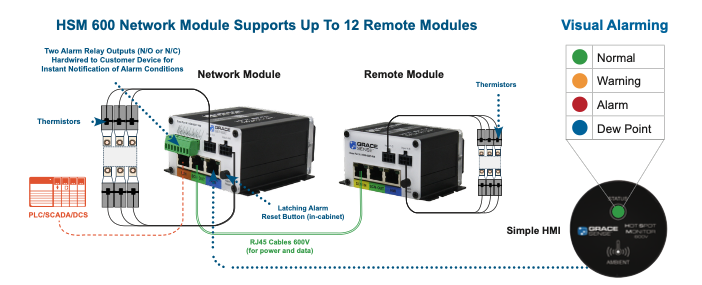
The HSM 600 architecture is built around a distributed monitoring approach:
- Thermistors installed directly at critical connection points
- Network module mounted inside the enclosure
- Status display mounted externally for at-a-glance condition visibility
- Expansion capability via remote modules
This design allows facilities to monitor multiple termination points within a single cabinet, providing early indication of abnormal temperature rise.
Instead of relying solely on annual or quarterly IR inspections, facilities can monitor trends continuously and act before a failure escalates.
Continuous Thermal Monitoring vs. Periodic Scans
Infrared inspections remain valuable — but they represent a moment in time.
Continuous Thermal Monitoring (CTM) complements IR by:
- Monitoring between inspections
- Detecting temperature drift over time
- Identifying gradual resistance build-up
- Supporting condition-based maintenance strategies
For facilities seeking to reduce downtime and support proactive maintenance programs, continuous monitoring closes the visibility gap.
Built for Industrial Reality
Low-voltage equipment environments are demanding. The HSM 600 is designed to integrate cleanly inside existing cabinets and operate reliably within industrial settings.
Key benefits include:
- Designed specifically for ≤600 VAC applications
- Modular architecture for scalable monitoring
- External status visibility for quick identification
- Supports documented equipment condition
- Enables earlier intervention before catastrophic failure
This makes it well suited for manufacturing plants, commercial buildings, utilities, and especially data center electrical distribution systems where uptime is critical.
Supporting Modern Electrical Safety Programs
As maintenance standards evolve, documenting equipment condition and demonstrating that equipment is operating under normal conditions becomes increasingly important.
Continuous Thermal Monitoring can play a role in:
- Supporting risk assessments
- Informing maintenance intervals
- Providing documented trend data
- Enhancing visibility into electrical asset health
For organizations focused on strengthening electrical safety and reliability programs, monitoring low-voltage equipment continuously provides another layer of protection.
Introducing the New GraceSense HSM 600
The GraceSense Hot Spot Monitor 600 (HSM 600) provides continuous thermal monitoring (CTM) for systems up to 600V.
By installing powered thermistor-based sensors at critical connection points, the system continuously monitors temperature behavior and compares it against ambient conditions. When abnormal heat rise is detected, the system provides clear indication so teams can investigate early.
The objective is straightforward: detect developing conditions sooner and support more informed maintenance decisions.
.jpg?width=2296&height=2296&name=HSM600%20Social%20Ads%2026019%20(1).jpg)
What the HSM 600 Delivers
The HSM 600 supports modern condition-based maintenance strategies by providing:
- 24/7 Real-Time Monitoring: Continuously tracks temperature trends under real operating conditions.
- Reduce Arc Flash Exposure: Eliminates routine panel openings and reduces exposure to incident energy.
- Designed for low-voltage equipment (up to 600V): Built for LV applications including PDUs, RPPs, MCCs, and panelboards.
- Rise-over-Ambient Accuracy: Built for LV applications including PDUs, RPPs, MCCs, and panelboards.
- Dew Point & Smart Alarming: Configurable thresholds and latching alarms detect thermal and condensation risks early.
- Scalable Architecture: Monitor up to 72 connection points without extra power supplies or complex networking.
- Seamless PLC & SCADA Integration: Supports EtherNet/IP™ and Modbus TCP/IP with built-in web configuration.
Because the system is always monitoring, it helps address the visibility gap left by periodic inspections.
Ready to See the HSM 600 in Action?
The HSM 600 is now available for teams looking to strengthen low-voltage thermal visibility and reduce unexpected failures. Explore the HSM 600 Datasheet & request a free product sample below!

To safer, smarter operations,